The UK National Homebrew Competition for 2012 has recently been announced.
This one completely missed my radar until after the closing date for entries last year so I missed out but from what I understand is was a very well supported competition.
What I particularly like about this one is that all entries receive a judges score sheet and feedback within a week or so of judging. It is always very useful to receive constructive criticism on our home brewing efforts and I believe is a key step in progressing as a brewer or brewster.
The competition opens for registration from 1st January 2012 and registration then closes 8th September 2012.
Entries can be received from 20 August 2012 through 7 September 2012.
Judging will be 15 September 2012 at a location to be confirmed. Prizes will then be awarded from 4pm.
The judging is based on BJCP 2008 categories with the best beers in each category being entered for a chance to win best of show.
It is also possible for clubs to win awards by accruing points from individual entries.
All the information for the competition is available here.
Lets hope for continued good support for brewing competitions like this one.
Happy Brewing!
Thursday, 5 January 2012
Wednesday, 4 January 2012
Lazy Brew Day - Update
So, if you read my last post you'll also know that recently I brewed a full mash kit, designed and packaged by a real micro brewery.
The Fulstow Brewery Fulstow Common is a copper coloured session bitter that comes in at around 3.8% ABV.
As I wrote before, the kit was very well put together and good value for money. The fermentation went well and I bottled the beer about a week ago.
One week in the bottle, even for AG brewing, is quite soon to be sampling but I was keen to try it out and see if it in anyway matches what I would normally drink at the pub. I have got to say that it does, although it could do with a few more weeks to mature and come into condition.
The carbonation levels at the moment are quite low and the lack of conditioning can be seen from the pitiful, almost non-existent head on the beer at the moment. However this I am sure will improve given time.
At this stage it definitely gives hints of the commercial beer but lacks a bit of that rounded flavour that comes in a well conditioned beer. At the moment it is still possible to pick out some of the flavours which are still very distinct and haven't blended together like they should but even now it resembles the beer that I can buy from the brewery tap on any night of the week.
Given another week in secondary fermentation and then a few weeks at cellar temperatures then this should be spot on. I think the outcome of this "kit" has been much better than I had hoped for. Although the instructions accompanying the kit were comprehensive and detail, the scaling down of a commercial recipe and the brewing of that recipe on home brew equipment can be difficult to get right.
The other factor is that people brew using different processes. I ignored some of the instructions on the kit so I could brew using my usual process, including my own water treatment, mash schedule and brew length.
The reason for doing this is that I know from experience that it's the process works best on my setup and produces predictable results. The instructions provided would work just as good for anyone that is just starting out in their AG brewing journey and is uncomfortable in winging it with their own process.
For the beer to have turned out as good as it has it testament to the time and thought that must have gone into designing and producing this full mash kit. I would certainly recommend any of the kits in this range to any home brewer, whatever their level of experience or expertise.
All that is left for me to do is to sign off with a picture of the beer. Ok.... my brewing is better than my photography (and indeed my writing).
Happy Brewing!
The Fulstow Brewery Fulstow Common is a copper coloured session bitter that comes in at around 3.8% ABV.
As I wrote before, the kit was very well put together and good value for money. The fermentation went well and I bottled the beer about a week ago.
One week in the bottle, even for AG brewing, is quite soon to be sampling but I was keen to try it out and see if it in anyway matches what I would normally drink at the pub. I have got to say that it does, although it could do with a few more weeks to mature and come into condition.
The carbonation levels at the moment are quite low and the lack of conditioning can be seen from the pitiful, almost non-existent head on the beer at the moment. However this I am sure will improve given time.
At this stage it definitely gives hints of the commercial beer but lacks a bit of that rounded flavour that comes in a well conditioned beer. At the moment it is still possible to pick out some of the flavours which are still very distinct and haven't blended together like they should but even now it resembles the beer that I can buy from the brewery tap on any night of the week.
Given another week in secondary fermentation and then a few weeks at cellar temperatures then this should be spot on. I think the outcome of this "kit" has been much better than I had hoped for. Although the instructions accompanying the kit were comprehensive and detail, the scaling down of a commercial recipe and the brewing of that recipe on home brew equipment can be difficult to get right.
The other factor is that people brew using different processes. I ignored some of the instructions on the kit so I could brew using my usual process, including my own water treatment, mash schedule and brew length.
The reason for doing this is that I know from experience that it's the process works best on my setup and produces predictable results. The instructions provided would work just as good for anyone that is just starting out in their AG brewing journey and is uncomfortable in winging it with their own process.
For the beer to have turned out as good as it has it testament to the time and thought that must have gone into designing and producing this full mash kit. I would certainly recommend any of the kits in this range to any home brewer, whatever their level of experience or expertise.
All that is left for me to do is to sign off with a picture of the beer. Ok.... my brewing is better than my photography (and indeed my writing).
Happy Brewing!
Thursday, 22 December 2011
Lazy Brew Day
Due to being busy with work and family commitments I've found it difficult to fit in any brew days for a few months now - since mid-September in fact.
I managed to fit in an emergency brew day a few weeks ago to stock up for Christmas, brewing an old favourite that I knew would be ready for drinking in a short space of time.
Today is my first day of the Christmas holidays and felt it time to put another brew on ready for the New Year. Again I didn't want to do anything adventurous and wanted something tried and tested that would get me ready for more experimental stuff after Christmas.
I decided to go for a Full Mash "kit". The last time I did one of these it was the Brupaks London Bitter kit which turned out wonderfully as it was my first attempt at a full mash beer. All the ingredients were measured out and packaged in a kit with some instructions. The only down side was that the instructions were rather generic and it wasn't made clear as to what the hop schedule should be.
My local micro brewery pub is Fulstow Brewery's Gas Lamp pub so I was interested to find that they sold kits of their beers at the local home brew shop. All of these kits are based on the breweries commercial beers, be it regular beers like Fulstow Common (my favourite) or one-off special beers like Wafty Crank.
The kits themselves are very well put together. They contain all the ingredients required (Grain and hops), the yeast, yeast nutrient, and a sachet of protofloc. It also comes with a set of very detailed instructions which would be particularly useful for an inexperienced brewer.
Everything is individually packaged and clearly labelled. The hops are separated into bittering and aroma and the instructions explain very clearly what should be done and when. The hops come in hop bags in case the brewer doesn't have a hop filter and can be dropped in inside the bag or emptied out into the boiler to do their thing as nature intended.
The kits themselves are very reasonably priced - especially considering the quality of the kit and the contents provided. It is based on a brew house efficiency of about 80% which I don't have a problem achieving but it might be a consideration for anyone new to AG brewing.
At the end of the brew day I've ended up with 23 ltrs of wort at an OG of 1.038. So here's some pictures of the days events.
All in all a successful and enjoyable day of brewing without the normal messing with scales and weighing.
Happy days!
I managed to fit in an emergency brew day a few weeks ago to stock up for Christmas, brewing an old favourite that I knew would be ready for drinking in a short space of time.
Today is my first day of the Christmas holidays and felt it time to put another brew on ready for the New Year. Again I didn't want to do anything adventurous and wanted something tried and tested that would get me ready for more experimental stuff after Christmas.
I decided to go for a Full Mash "kit". The last time I did one of these it was the Brupaks London Bitter kit which turned out wonderfully as it was my first attempt at a full mash beer. All the ingredients were measured out and packaged in a kit with some instructions. The only down side was that the instructions were rather generic and it wasn't made clear as to what the hop schedule should be.
My local micro brewery pub is Fulstow Brewery's Gas Lamp pub so I was interested to find that they sold kits of their beers at the local home brew shop. All of these kits are based on the breweries commercial beers, be it regular beers like Fulstow Common (my favourite) or one-off special beers like Wafty Crank.
The kits themselves are very well put together. They contain all the ingredients required (Grain and hops), the yeast, yeast nutrient, and a sachet of protofloc. It also comes with a set of very detailed instructions which would be particularly useful for an inexperienced brewer.
Everything is individually packaged and clearly labelled. The hops are separated into bittering and aroma and the instructions explain very clearly what should be done and when. The hops come in hop bags in case the brewer doesn't have a hop filter and can be dropped in inside the bag or emptied out into the boiler to do their thing as nature intended.
The kits themselves are very reasonably priced - especially considering the quality of the kit and the contents provided. It is based on a brew house efficiency of about 80% which I don't have a problem achieving but it might be a consideration for anyone new to AG brewing.
At the end of the brew day I've ended up with 23 ltrs of wort at an OG of 1.038. So here's some pictures of the days events.
| Preparing the brewing liquor - 31ml of CRS to reduce the residual alkalinity to around 50ppm CaCO3 |
| 2tsp Gypsum & 3/4 tsp Calcium Chloride |
| My brewery.... Tidy isn't it :p |
| Mashing in |
| Mash set at 65oC (as per instructions guv'). Mash is for 60mins today. |
| Sparge run off |
| The hop shot! |
| Mmmmm malty smooth |
| Nearly there |
| ....and rest. |
| An alien life form? |
| Spot on 1.038 - Huzzah! |
| Break material dropping clear. |
Happy days!
Wednesday, 10 August 2011
The Great British Homebrew Challenge 2011
Homebrewing beer has come a long way over the years. All Grain brewing is becoming more and more popular. I think the age of technology and the interweb have all played their part in helping this brewing explosion in peoples kitchens, garages, gardens and even the odd shed or two.
Most home brewers can produce quality beers on mostly cobbled together equipment, trying to emulate the ever expanding craft and micro brewers throughout the country, many of whom also started off brewing as a hobby.
One thing that all home brewers like is constructive feedback on their beers, allowing for a never ceasing circle of continuous improvement to process and a better understanding of how to brew really great beers. It is a fantastic hobby to get involved in and has it's rewards at the end - being the end product that can be shared (with friends, family and even strangers via the brew exchange) or kept for personal enjoyment.
Another way of recieving feedback on beers is to enter brewing competitions. However, over the last few years I've realised that the main problem with the success of home brew competitions is the size of the entry, and also the large national competitions are few and far between. Yes, there are national competitions run on a small scale from Internet forums like the Brew Exchange but these never receive a huge amount of interest and eventually after a few competitions the interest seems to die completely.
So it's with a certain amount of excitement that I am now planning for possibly 3 entries into The Great British Homebrew Challenge 2011. Being run by the award winning Thornbridge Brewery in conjuntion with Nicholsons Pubs. There are cash prizes for best in each category with the overall winner being selected by Nicholsons Pubs to be brewed by Thornbridge and served as a beer nationwide in the pub chain.
So now I have some decisions to make. I can enter up to 3 separate categories. Unfortunately 2 of the I'm currently thinking of brewing fall into the same category so I think I need to do some playing around in Beersmith 2. Still, it keeps me off the streets! ;)
So come on fellow homebrewers out there. Don't be afraid to get stuck in. Let's make this homebrew competition a success. Show off your beer and be proud of crafting a quality product from an enjoyable and friendly hobby.
Most home brewers can produce quality beers on mostly cobbled together equipment, trying to emulate the ever expanding craft and micro brewers throughout the country, many of whom also started off brewing as a hobby.
One thing that all home brewers like is constructive feedback on their beers, allowing for a never ceasing circle of continuous improvement to process and a better understanding of how to brew really great beers. It is a fantastic hobby to get involved in and has it's rewards at the end - being the end product that can be shared (with friends, family and even strangers via the brew exchange) or kept for personal enjoyment.
Another way of recieving feedback on beers is to enter brewing competitions. However, over the last few years I've realised that the main problem with the success of home brew competitions is the size of the entry, and also the large national competitions are few and far between. Yes, there are national competitions run on a small scale from Internet forums like the Brew Exchange but these never receive a huge amount of interest and eventually after a few competitions the interest seems to die completely.
So it's with a certain amount of excitement that I am now planning for possibly 3 entries into The Great British Homebrew Challenge 2011. Being run by the award winning Thornbridge Brewery in conjuntion with Nicholsons Pubs. There are cash prizes for best in each category with the overall winner being selected by Nicholsons Pubs to be brewed by Thornbridge and served as a beer nationwide in the pub chain.
So now I have some decisions to make. I can enter up to 3 separate categories. Unfortunately 2 of the I'm currently thinking of brewing fall into the same category so I think I need to do some playing around in Beersmith 2. Still, it keeps me off the streets! ;)
So come on fellow homebrewers out there. Don't be afraid to get stuck in. Let's make this homebrew competition a success. Show off your beer and be proud of crafting a quality product from an enjoyable and friendly hobby.
Saturday, 6 August 2011
Wolds Bitter
A while back now I blogged about doing an Ordinary Bitter. it was a case of having most other styles sorted in terms of my own house recipes except for a standard, session bitter.
The brew started off well, hitting all the numbers on the brew day but then I started having yeast issues in fermentation. The liquid yeast I pitched first just didn't get going so eventually I repitched with some Windsor yeast. The Windsor yeast did the job but when the beer went into secondary it was looking a bit on the murky side.
To cut a long story short, it took an age to clear and wasn't tasting that good. Finally in the last few weeks it has dropped bright and clear and the flavour has been transformed. I designed the recipe to have some of the fruity flavours that you get in a Riggwelter but in a smaller beer and with more bitterness.
Although I wanted a smaller beer I still wanted it to have somebody and balance about it. So here it is - weighing in at about 3.8% ABV with a bitterness of around 35 IBUs.
I'll definitely rebrew this but next time with a yeast that'll get to work on it straight away. Maybe Thames Valley liquid yeast or even a Nottingham dried yeast.

The brew started off well, hitting all the numbers on the brew day but then I started having yeast issues in fermentation. The liquid yeast I pitched first just didn't get going so eventually I repitched with some Windsor yeast. The Windsor yeast did the job but when the beer went into secondary it was looking a bit on the murky side.
To cut a long story short, it took an age to clear and wasn't tasting that good. Finally in the last few weeks it has dropped bright and clear and the flavour has been transformed. I designed the recipe to have some of the fruity flavours that you get in a Riggwelter but in a smaller beer and with more bitterness.
Although I wanted a smaller beer I still wanted it to have somebody and balance about it. So here it is - weighing in at about 3.8% ABV with a bitterness of around 35 IBUs.
I'll definitely rebrew this but next time with a yeast that'll get to work on it straight away. Maybe Thames Valley liquid yeast or even a Nottingham dried yeast.
Tuesday, 26 July 2011
Dark Dog Coffee Stout
My last post mentioned plans for a coffee stout using a cold infusion of ground coffee.
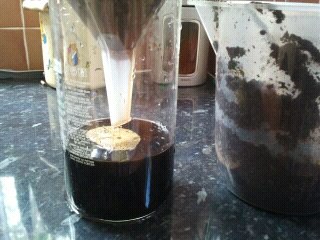
I brewed a robust stout based loosly on a couple of old favourites of mine. Once this was finishing primary fermentation I racked it off to a secondary fv on top of the cold coffee infusion that I had prepared a few days before in the fridge.
Before adding the coffee infusion I filtered the coffee grains using a paper filter.
Allof this went into bottles for freshness.
Early samples were a bit poor. There was some harshness to the beer and a strange aftertaste from the coffee. However, given some conditioning time and this has transformed into an extremely drinkable beer.
It pours dark black with a light carbonation with an off white, almost brown, but creamy head which lasts down the glass.
The coffee compliments the roastiness of the beer and the bitterness is about right for my tastes.
Don't get me wrong though. This is not a subtle beer. It's an assertive and complex pint that can fullfill my desire for coffee and beer in one glass.
I'll definitely consider brewing this one again.


I brewed a robust stout based loosly on a couple of old favourites of mine. Once this was finishing primary fermentation I racked it off to a secondary fv on top of the cold coffee infusion that I had prepared a few days before in the fridge.
Before adding the coffee infusion I filtered the coffee grains using a paper filter.
Allof this went into bottles for freshness.
Early samples were a bit poor. There was some harshness to the beer and a strange aftertaste from the coffee. However, given some conditioning time and this has transformed into an extremely drinkable beer.
It pours dark black with a light carbonation with an off white, almost brown, but creamy head which lasts down the glass.
The coffee compliments the roastiness of the beer and the bitterness is about right for my tastes.
Don't get me wrong though. This is not a subtle beer. It's an assertive and complex pint that can fullfill my desire for coffee and beer in one glass.
I'll definitely consider brewing this one again.


Wednesday, 18 May 2011
A Flurry of Activity
Even writing the title to this blog entry has got my mind racing about whether trying to make a Mc Flurry beer would be a good idea or not! I'm not quite sure what has happened to me over the last few weeks in fact. Maybe I'm finally coming out of my long period of winter hibernation?
Whatever it is, it's spurred me into thinking and doing homebrew (alot!).
In fact, running out of beer the other weekend might have been partially to blame for this brewing explosion. Now I'm back to a point where I have some established regulars either conditioning or fermenting away and so my mind turns to the more experimental brews - after all that's where the old favourites started off. However experimenting has it's risks and a fair proportion of the experiments will be dropped as bad ideas and never brewed again- the odd one or too are that bad that they are a struggle to finish off.
Recently, and apart from the usual bitters and pale ales, I have brewed lager style beers but using mostly ale type ingredients and yeasts. At this time of year I can't ferment a proper lager yeast and I'm only brewing it to keep the beer guests happy. (Note to self: invest in fermentation temperature control - it's the future!).
Anyway, this morning I was hankering after a good strong black coffee to kick start the day and found that we didn't have any in the house - that's none at all - no filter, no instant, no cafetiere... nothing. Actually we do have a bag of coffee beans that I picked up by mistake thinking it was ground but having no grinder makes getting a decent cup of coffee out of it a bit difficult (I've already been spoken to about blunting the blade on the food processor and the pestle and morter just doesn't cut the mustard).
Obviously this lack of coffee was playing on my mind and so the thought of doing a Coffee Stout crept into my concience. That seed of a thought has grown all morning until I felt impelled to take this further.
So..... I decided on a base recipe for the stout. Something that already has hints of coffee in the malt profile.. This will be brewed as is but a few days before the end of fermentation I will add around 250g of ground roast coffee into a pint of cold filtered water. After stirring this up it will be kept in the fridge for 24 hrs or so before filtering and adding to the secondary fermentor ready for bottling. This cold infusion is supposed to reduce the harsh bitterness of hot coffee but allows the coffee essense to be carried across into the final beer. Well that's the plan!
To de-risk the whole thing I've designed the base recipe by "borrowing" elements from existing recipes for FSOS and my Dark Dog Porter (already based on Gadds Dogbolter recipe).
At the moment the draft version of the recipe goes something like this.
Pale (MO) Malt - 75%
Malted Oats - 4%
Torrefied Wheat - 5%
Chocolate Malt - 5%
Roast Barley - 2%
Amber Malt 5%
Carafa III Sp. 4%
Aiming for an OG of around the 1.044 mark and will mash at about 68oC using a sweet stout water profile.
I will bitter fairly low for a stout at around 35 IBUs using target and goldings with very few late hops.
I'll be sure to post an update when I brew and have tasted the results. In the meantime..... it must be about time to start planning a fruit cake Christmas ale.
Happy Days!
Whatever it is, it's spurred me into thinking and doing homebrew (alot!).
In fact, running out of beer the other weekend might have been partially to blame for this brewing explosion. Now I'm back to a point where I have some established regulars either conditioning or fermenting away and so my mind turns to the more experimental brews - after all that's where the old favourites started off. However experimenting has it's risks and a fair proportion of the experiments will be dropped as bad ideas and never brewed again- the odd one or too are that bad that they are a struggle to finish off.
Recently, and apart from the usual bitters and pale ales, I have brewed lager style beers but using mostly ale type ingredients and yeasts. At this time of year I can't ferment a proper lager yeast and I'm only brewing it to keep the beer guests happy. (Note to self: invest in fermentation temperature control - it's the future!).
Anyway, this morning I was hankering after a good strong black coffee to kick start the day and found that we didn't have any in the house - that's none at all - no filter, no instant, no cafetiere... nothing. Actually we do have a bag of coffee beans that I picked up by mistake thinking it was ground but having no grinder makes getting a decent cup of coffee out of it a bit difficult (I've already been spoken to about blunting the blade on the food processor and the pestle and morter just doesn't cut the mustard).
Obviously this lack of coffee was playing on my mind and so the thought of doing a Coffee Stout crept into my concience. That seed of a thought has grown all morning until I felt impelled to take this further.
So..... I decided on a base recipe for the stout. Something that already has hints of coffee in the malt profile.. This will be brewed as is but a few days before the end of fermentation I will add around 250g of ground roast coffee into a pint of cold filtered water. After stirring this up it will be kept in the fridge for 24 hrs or so before filtering and adding to the secondary fermentor ready for bottling. This cold infusion is supposed to reduce the harsh bitterness of hot coffee but allows the coffee essense to be carried across into the final beer. Well that's the plan!
To de-risk the whole thing I've designed the base recipe by "borrowing" elements from existing recipes for FSOS and my Dark Dog Porter (already based on Gadds Dogbolter recipe).
At the moment the draft version of the recipe goes something like this.
Pale (MO) Malt - 75%
Malted Oats - 4%
Torrefied Wheat - 5%
Chocolate Malt - 5%
Roast Barley - 2%
Amber Malt 5%
Carafa III Sp. 4%
Aiming for an OG of around the 1.044 mark and will mash at about 68oC using a sweet stout water profile.
I will bitter fairly low for a stout at around 35 IBUs using target and goldings with very few late hops.
I'll be sure to post an update when I brew and have tasted the results. In the meantime..... it must be about time to start planning a fruit cake Christmas ale.
Happy Days!
Subscribe to:
Posts (Atom)